
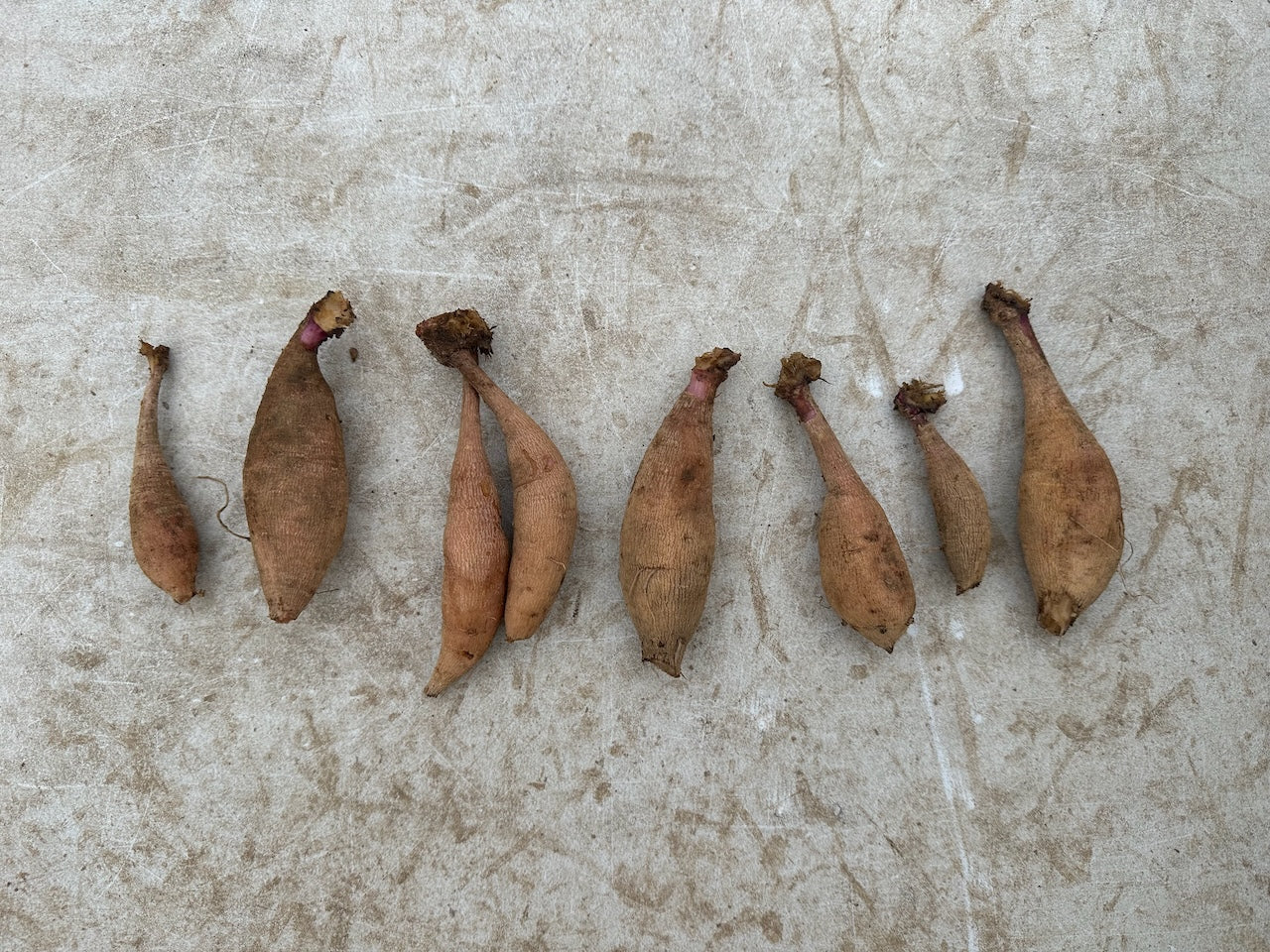
The art of dividing your dahlias is a simple yet essential technique for multiplying your favorite varieties, optimizing your storage space, and preserving the vigor of your plants. We're pleased to continue this series of blog posts dedicated to dahlias with the topic of tuber division.

At Floramama, the division is done directly after harvesting and washing the tubers. We could do it in the spring, but we have more time at this time of year, and it optimizes storage space. If we need to keep them waiting a few days, or even a few weeks, between harvest and division, it is essential to keep them in a dark and cool place (5-10 degrees Celsius) in the meantime.
Whether the division is done in autumn or spring, know that this does not affect their productivity in any way!
Why divide dahlias?
Dividing dahlias has several advantages:
- Maintaining plant health : Tubers become congested over time, which can reduce their ability to produce beautiful flowers. For a flower farm, this process is done annually, but at home, dividing dahlias every 2 to 3 years is a good practice to maintain their vigor and ensure abundant blooms.
- Multiplying your dahlias : Division allows you to create new plants from a single tuber.
- Improve flowering : Divided dahlias have more room to grow, which promotes more abundant flowering.

Parts of a tuber
- The crown :
- This is the upper part of the tuber where the eyes (the buds that will produce new shoots) form . It connects the tubers to the rest of the plant.
- The crown is essential for division because it is where the growing points (eyes) are located. If there are no eyes, the tuber becomes useless.
- The neck :
- This is the narrow section that connects the main tubercle to the crown.
- An intact neck is important because it is through it that nutrients pass between the crown and the tuber. If the neck is broken or damaged, the tuber becomes useless.
- The body of the tuber :
- It is the fleshy, swollen part that stores the nutrients needed for growth and flowering.
- Although it provides energy to the plant, a tuber without a crown and eyes will not be able to produce new shoots.
- If the body is damaged to more than 50% of its surface, the tuber becomes useless.

Necessary material
- A small to medium sized pruning shears
- Larger pruning shears or a knife (watch your fingers!)
- A clean surface to work on
- Disinfectant made up of 10 parts water to 1 part bleach. (We put it in a small sprayer to make it easier to apply to the pruning shear blades)
- A compost bin
- Antifungal powder (optional)

Steps to Dividing Dahlias
Once the dahlias have been dug up and washed, here's what to do:
1. Identify viable tubers
- First identify tubers that are in good condition (crown, neck and body).
2. Divide the tubers
- Look near the crown to locate the eyes. These small protrusions are the future shoots. If there are no eyes, the tuber becomes useless.
- Using sharp, disinfected pruning shears, cut the tubers into large sections as needed to begin, then divide them into smaller sections to try to separate them individually without damaging the eyes. Each section should have at least one eye. If there are no eyes, the tuber is useless.
- Discard soft or damaged tubers in the compost. It's normal to have up to 50% loss due to handling the tubers during harvesting and washing. It's heartbreaking, but it's normal!
3. Apply an antifungal treatment (optional)
- Dust the cut areas with an antifungal powder to prevent disease. Ground cinnamon is a natural and effective option for protecting dahlias after division, thanks to its antifungal properties. One to two tablespoons is enough to treat several tubers.
- Please note that we do not use any antifungal powders at Floramama. Our storage technique is effective enough to virtually eliminate any risk of rot!
4. Store or replant
- If you divide your dahlias in the fall, store the tubers in a cool, dry place until spring. See the article on storing tubers.
- In spring, plant the divided tubers promptly in well-drained soil. See blog post on growing dahlias

Tips for a successful division
- Disinfect tools between each plant to avoid spreading diseases/viruses (Bacterial rot (Erwinia spp.), Dahlia mosaic virus (DMV))
- Immediately discard (do not divide) plants showing signs of leafy gall caused by Rhodococcus fascians in the garbage . This is called leafy gall or vegetative gall . Abnormal growths, a very large number of eyes clustered in one place.
- Always, always, always label dahlia varieties if growing multiple types.
Whether you're optimizing space, multiplying your favorite varieties, or ensuring generous blooms, we believe our technique is within everyone's reach, with a little preparation and attention. By following our advice, you'll fully enjoy your dahlias, season after season. Don't forget to check out our other articles for tips and tricks on storing or planting tubers. Happy dividing


1 comment
Diviser les tubercules de dahlias est une étape essentielle pour encourager une croissance saine et obtenir de nouvelles plantes. L’article détaille avec clarté les étapes à suivre, en soulignant l’importance de la période de division, qui devrait idéalement se faire au printemps, après la période de dormance. Visit us Telkom University Jakarta