
Tulips are among the easiest flowers to grow, and they're also among the most rewarding to harvest, with their long stems and generous blooms. They come in a multitude of bold and nuanced colors, with styles ranging from classic to funky!
At Floramama, we grow tens of thousands of them every year because they're one of the most popular crops on the farm, and we never tire of harvesting them. Along with daffodils, they're the first to show up in spring, when everyone is hungry for flowers, color, and freshness after a long, cold, white winter.
This year, a record 56,000 (!) tulip bulbs were planted. Since autumn is just around the corner, we're sharing our simple tips and techniques for growing them yourself. 

Growing tulips as annuals or perennials
First of all, you should know that tulip and daffodil bulbs are much more expensive to buy than seeds.
Here at the farm, we grow tulips as annual plants, meaning we harvest the flower with the bulb. We do this to have the longest possible stems for bouquets, and also to keep the tulips in cold storage longer. Since their energy source (the bulb) is still attached to the flower after harvest, they stay very fresh for much longer (about two weeks in cold storage). We will then cut the bulb from the stem only when making bouquets.
If you're not growing tulips commercially, you might decide to leave the bulbs in the ground and treat your tulips as perennials. This way, your plant will stay in the ground and produce flowers year after year. To do this, if you want to harvest your flowers in the spring, you'll simply need to make sure to cut the stem so that at least three leaves remain on the mature plant so that the bulb can regenerate through photosynthesis once flowering is over.
Bulbs are therefore a more significant investment to make initially, but which will pay off in the long term if you keep them for several years!
Autumn planting
In Quebec, tulip bulbs are planted in the fall. There is no specific date to follow. They can be planted as soon as they are available, as long as the soil is not frozen solid, is still loose, and can be worked. Ideally, the bulbs should be able to develop some roots for a few weeks before the big cold weather sets in. That said, we have planted bulbs very late more than once, and the quality of the blooms in the spring was not diminished!
Tulips are not planted in spring because they need a vernalization period, meaning they need a good cold spell to initiate their flowering. In Quebec, our long, cold winters are perfect for giving the bulb all the resources it needs to produce a beautiful bloom in spring. The colder the winter, the longer the stem!
How to plant your bulbs
We're sharing our technique for growing tulips for a flower farm, but it also applies to a smaller garden space at home, with a few exceptions:
2. Calculate the total area your bulbs will cover in this space.
3. If you're using a large area, place a tarp on the ground next to your bed. This will help you easily collect all the soil you've dug up.
4. Dig the entire bed or garden area to a depth of 6 inches (or 15 cm). If using a tarp, place the excavated soil on top of the bed. Make sure you plant your bulbs deep enough. If they are planted too shallow, they will produce shorter stems.
5. Loosen (work the soil to make it softer) the soil at the bottom of the hole with a broadfork or a fork.
6. When planting tulips as perennials, amend the soil with a generous amount of mature compost and/or fertilizer (preferably organic) to increase organic matter and beneficial organisms in the soil and thus optimize plant health over time . Refer to the manufacturer's instructions for quantities. Mix the loosened soil, compost, and fertilizer together.
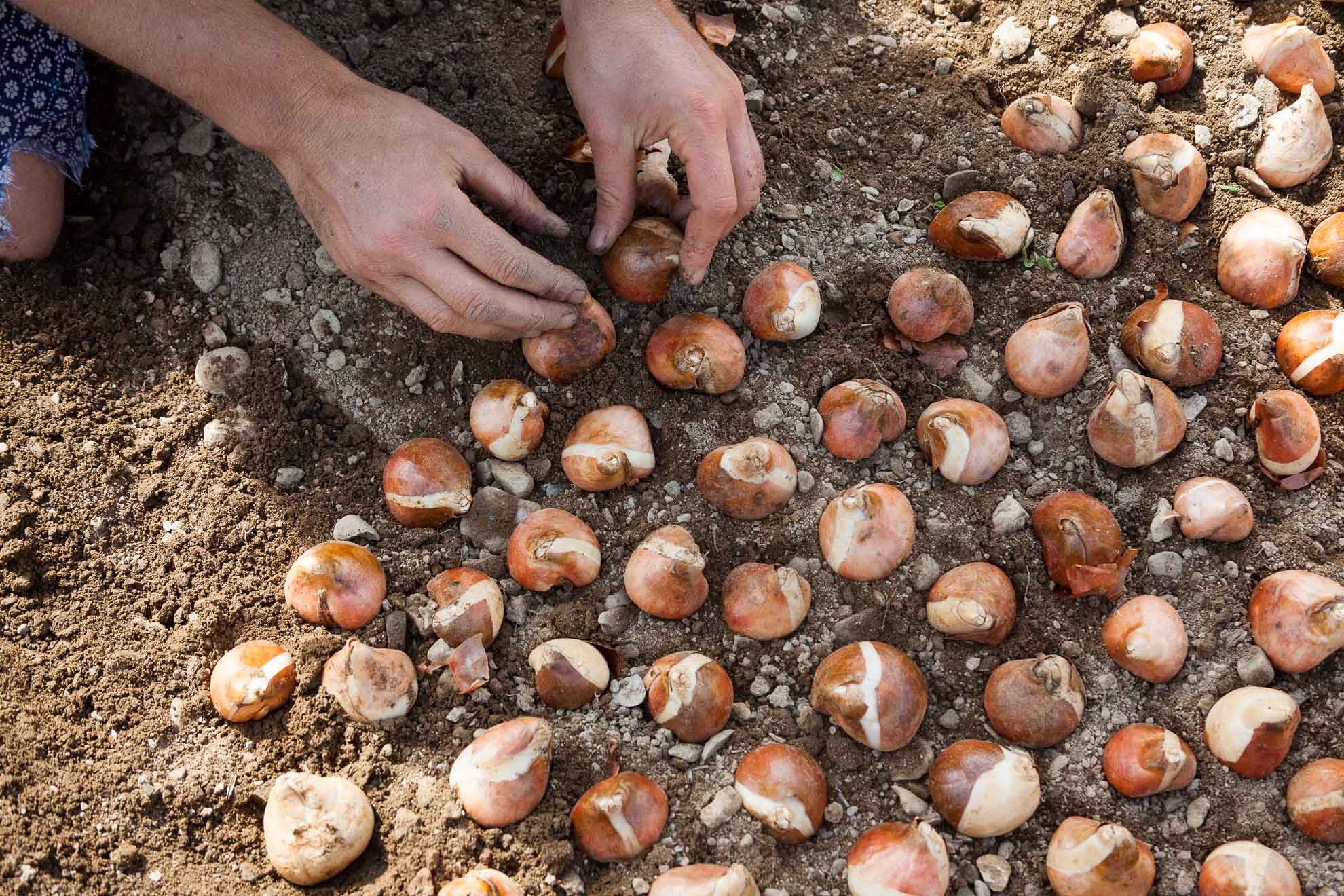
7. Arrange your bulbs on the prepared area. For a perennial garden, place the bulbs with the pointed ends up about 3 inches (7.5 cm) apart. For a flower farm where tulips are grown as annuals, arrange the bulbs on the bed 1" or 2.5 cm apart, always with the pointed ends up, like eggs in an egg carton.
8. Irrigate (water) deeply.
9. Cover the bulbs with the previously dug soil, without compacting the soil. The tarpaulin will make it easier to collect all the soil.
10. Clearly identify the location and varieties planted using visual markers such as small sticks, where you will write down the varieties planted as you go.
11. If growing under plastic, irrigate deeply a few times during the winter to keep the soil moist but never soggy.

Grow in a caterpillar tunnel or cold greenhouse to extend the flowering period
Growing tulips in a caterpillar tunnel or in a cold greenhouse also allows us to play a little with the flowering period of our tulips. For the same variety, if we grow it in a caterpillar tunnel (one layer of plastic), we can calculate a flowering about a week earlier than outdoors. If we grow it in a cold greenhouse (two layers of plastic), we can plan a flowering about two weeks earlier than outdoors.
And there you have it! Be patient and wait for spring!
We don't have a squirrel problem on the farm, but if you live in a suburban or urban area, it's possible that squirrels will dig up your newly planted bulbs. For those who have this problem, here are some options available online .


12 comments
Je viens de placer ma commande. J’ai hâte des les planter!! Merci pour les bonnes explications. Je me demande, si je les laisse plantés comme vivaces, elles se multiplierons avec le temps?
Instructions et explications tellement claires! Merci de partager votre expertise avec nous, c’est vraiment apprécié et si généreux !