
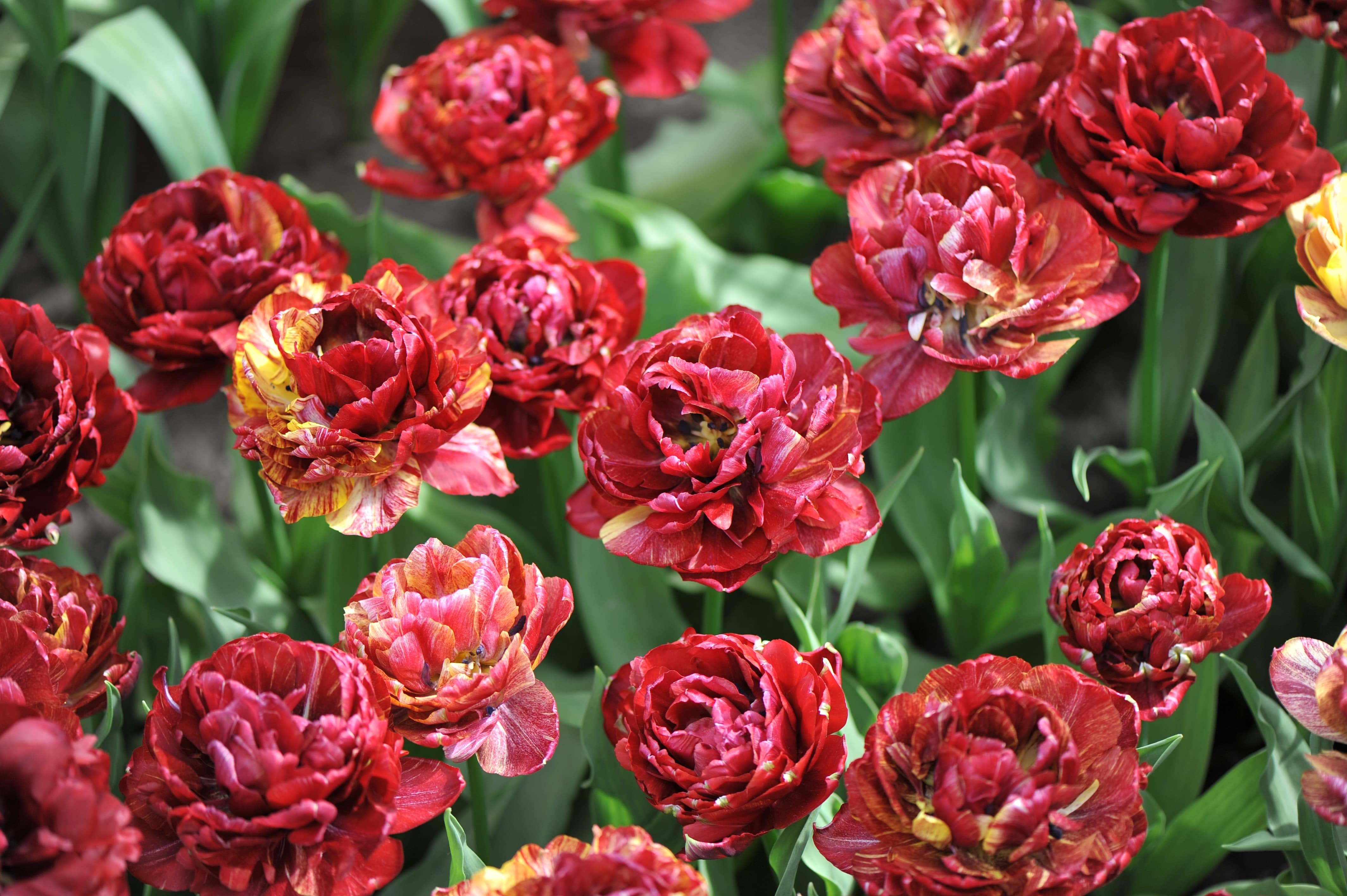
We all love getting our hands dirty in the fall, planting bunches of bulbs that hold within them the precious power to enchant our spring.
Yes, bulb flowers are perennial, but...!
For years, flower groupies (that we are!) have been selecting varieties of floriferous flowers: more petals, more colors, funky textures, bigger flowers etc… We love them because they are simply unique and out of the ordinary.
However, we note that the flowering of specialty tulips (parrots, doubles, viridiflora, modern Rembrandts, etc.) tends to fade after two or three springs or even disappear completely. This is a characteristic of the very nature of these varieties and the conditions in which they are grown.
As mentioned above, these are hybrids selected for their aesthetic qualities. And as in any selection process, the ability to regenerate and multiply naturally has been reduced. The majority of bulbs come from the Netherlands, which has been growing them for hundreds of years to supply the cut flower industry. This is why the persistence of the bulb is less important than these aesthetic qualities (length of stems, impressive flowering, etc.). For example, on the farm, we do not leave the bulbs in the ground, we harvest the tulips with their bulbs in order to store them in a cold room to extend their lifespan, the stems are only cut when they are put into bouquets to ensure maximum freshness for the customer.
The tulips best known for their naturalization are botanical tulips, which produce strong bulbs capable of dividing and persisting for decades. After flowering, the mother bulb fragments into several smaller bulblets. These are too small to flower the following year, and they must grow over several seasons before they do so.
Another very important factor that comes into play in flowering is the growing conditions.
In heavy or wet soil, bulbs risk rotting in the summer, especially when they are dormant and need to dry out. Even in well-drained soil, specialty tulips do not tolerate being left in the same place for several years: they tend to "sink" deeper into the soil as they regenerate, making it difficult to recover. This is why, in practice, they are often treated as annuals and replanted each year from bulbs produced in the Netherlands, where growing conditions are optimized for propagation.
Among the specialty tulips, we still notice varieties that come back much more than others, such as viridiflora, emperor and darwin tulips.
In summary, here is what the life cycle of a specialty tulip looks like:
Year 1: The spectacular flowering
The bulbs are well-calibrated, produced in Holland under ideal conditions (sandy soil, temperate climate, open-field cultivation, controlled uprooting and drying). These bulbs are full of reserves and designed to offer maximum flowering. When spring comes, the flowers are magnificent: large, colorful, true to the variety. The mother bulb has used a good part of its reserves to produce this bloom.
Year 2: Fragmentation
After flowering, the mother bulb regenerates, but it tends to fragment into several small bulbils. Some remain attached to the main bulb, others detach. The problem is that these bulbils are too small to flower the following year. The main bulb, however, has lost its vigor. The flowering the following spring is therefore often less generous: a few flowers are still beautiful, but often smaller or fewer in number.
Year 3: Dispersion
The process continues. The mother bulb becomes exhausted and sometimes disappears, leaving behind a handful of bulblets. These survive, but take several years to grow. In the meantime, the plot may appear empty or with only a few scattered flowers. The tulips appear to have "disappeared."
Years 4 and beyond: the rarefaction
At this stage, only the hardiest bulbils continue to grow. After four or five years, a few may become large enough to flower again, but never with the abundance and uniformity of the first spring. The spectacular initial carpet has turned into sporadic flowering. Many bulbils will have been lost, either by rotting from excess moisture or by remaining too small to survive.
In short: specialty tulips decline because the large initial bulb, bred to provide immediate flowering, quickly breaks down into small bulbs that are too weak to ensure continuity. This phenomenon is accentuated by soil moisture, which prevents proper regeneration. This is why it is recommended to treat them as annuals and replant each fall if you want to rediscover the spectacular effect of the first bloom each year.
For those who want to keep their stock going, there is still a solution: Multiplication
Propagating specialized horticultural tulips is possible, but it's neither guaranteed nor quick. Each mother bulb produces small side bulbs, called bulbils. These can be separated from the main bulb and replanted, but because they are very small, they usually take several years to flower. Many of these bulbils do not survive: some rot if the soil is too wet, others die before they have a chance to grow.
In good conditions—well-drained soil, sunny location, regular care—we can hope that less than half of these bulbils will succeed in developing and producing flowers after three to five years. In other words, it works, but you have to be patient and accept losses along the way. Botanical or Darwin tulips are much better suited to this, while highly hybrid varieties, such as parrots or doubles, are capricious and not well suited to home propagation.
The decline of specialty tulips after a few years is not simply explained by a temporary lack of energy, as if the plant was simply "hungry" and it simply needed to be fed more. It is linked to two combined realities:
-
Their genetic nature. These tulips are the result of extensive horticultural selection. They were chosen for their extravagant shapes, their distinctive colors, and their curled or multiple petals. But this selection has often come at the expense of their ability to multiply and persist over time. Unlike botanical species, which produce large, strong bulbs capable of dividing and regenerating for decades, specialty tulips form fragile bulbs that, after one or two blooms, tend to fragment into tiny bulblets. These bulblets take several years to flower, and many disappear before they do.
-
Their growing conditions. In nature, tulips spend the summer in dry conditions. In our gardens, especially in humid climates or heavy soils, the bulbs have difficulty drying out properly and risk rotting. Even in well-drained soil, they sink a little deeper each year as they regenerate, making it difficult for them to recover. The result is that flowering weakens or ceases after a few years if the bulbs are not renewed.
The real perennials
Among tulips, not all behave the same way in the garden. Some varieties are known to be more perennial, capable of reblooming faithfully for several years in a row, or even naturalizing. This is primarily the case for botanical tulips and certain hybrids close to these species. This group includes the Kaufmanniana, Fosteriana, Greigii, and Clusiana tulips, which not only offer a beautiful palette of colors but also remarkable longevity. Planted in well-drained soil, in full sun, they gradually multiply and form colonies that sometimes last for several decades.
Darwin hybrids, derived from crossing Fosteriana tulips with other varieties, are also considered good perennials. Their large, single, cupped flowers, often red or orange, generally rebloom for three to five years in a row before declining, provided they are given a dry location in summer. These hybrids are among the hardiest of modern horticultural tulips.
At Floramama, our heart is definitely in specialty tulips because they correspond to our aesthetic criteria and we are above all a farm that produces flowers with the aim of making magnificent bouquets! But we are always eager to share our knowledge in order to equip florists who want to bring beauty into their lives 🙂


