

Spring will be just around the corner in just a few days! Do you already have images of blooming gardens creeping into your mind? That's good, me too!
A great way to ensure you have exactly the varieties and colors you want in your garden is to start your own seedlings. In fact, it's entirely possible to achieve beautiful results with a homemade seed starter, which, seriously, is as simple as a warm spot with lights for your plants.

Generally, plants need 4 elements to thrive.
Earth, water, light, and heat. The disco ball is optional.

SOIL: To start your seeds you need high quality seed compost if you want good results, preferably organic or at least without chemical fertilizers.
Next, as containers, anything you can find that can hold this soil and drain water, including egg cartons, old pots, and plastic cups with holes in the bottom, will do. If you're reusing old pots, it might be a good idea to wash them with a 10% bleach solution to kill any pathogens that may have taken up residence there. Here at the farm, we exclusively use multi-cell trays. You'll find them in most garden centers this time of year.

These trays come in a variety of sizes, and choosing the right size can be daunting. Personally, I love easy, convenient solutions. We grow all our varieties in 128-cell trays, except for sweet peas, where we use 4” pots to allow them to develop a larger root system. The 72-cell tray is, in my opinion, the best choice for occasional gardeners because this type of tray contains more soil per cell, allowing the seedlings to be adequately nourished for a little longer. This way, no repotting is required, and you will end up with strong transplants that will have developed a nice root ball for transplanting.

WATER: Before sowing your seeds, moisten the soil without making it soggy. Once the seeds are in the ground, adding a cover (a transparent plastic dome, often sold as a “kit” with the trays) placed on the tray will retain moisture which, combined with heat, will accelerate the germination of your seeds. However, this is not mandatory.
Keep an eye out for any signs of germination and remove the dome as soon as the cotyledons have broken through the soil surface. Once the miracle of germination has taken place and the cover is removed, you'll need to continue watering your new seedlings as needed. But be careful: too much water = mold! Water them only when the soil on the surface has had time to dry out a little (the pale color of the soil and the light weight of the container are good indicators that it's time to water).

In a greenhouse where conditions are perfectly controlled, the satisfaction of watering with a high jet of water is immense. But to protect your beautiful floors, it can be very nice to install a material that will collect the droplets and, above all, to use a more suitable method.
The flat-bottomed sub-tray (without holes!) is a good option. Simply pour a little water into the flat-bottomed tray and place your seed trays inside. The bottom of the cells will be submerged (we want the holes in the multi-cell tray to be submerged) and irrigation will occur from the bottom. After a few minutes, you can remove the remaining water (or make sure the holes are no longer touching it).
There is also another method to fully irrigate the soil, called capillary action, which consists of having a single large container, not too deep (the height of a tray if possible) and filled with water where you place the trays one after the other so that they soak. We leave one tray at a time to soak on the surface of the water for a few minutes, making sure that it is never submerged, which would wash the seeds out of the tray. Once the tray is completely moistened, we take it out, keeping in mind that it will drain of its excess water.
Regardless of the method, it is important to let the potting soil dry out a little between waterings.
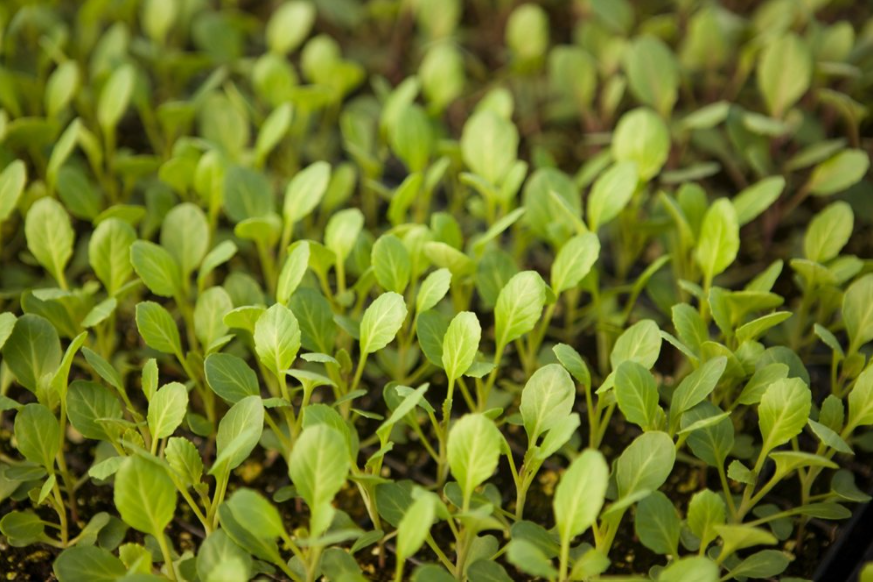
LIGHT: Some varieties have extremely long growing cycles and must be started early in the season. No need for a greenhouse or complex and expensive installations to do this; a very simple system installed in the house on shelves, with fluorescents, will do the job. At almost any hardware store, you can buy plant-specific lighting that will give them the full spectrum of light necessary for growth.
Make sure to give new seedlings about 14 to 16 hours of light per day. If the seedlings don't have access to this amount of natural light, provide artificial light. A very simple way to avoid forgetting to turn your lights on or off is to connect them to a timer. Hang the lights directly above your seedlings. As the seedlings grow, make sure to raise the lights so that they are 2" to 3" maximum above the tallest seedling.

WARMTH: Generally, for seeds to germinate quickly, they need to be kept warm. Find a comfortable spot, usually around 20°C, where you'll grow your seedlings. For the more motivated among you, purchasing a heat mat ($$$) can be a good option.

THE DISCO BALL: Make a large-scale color plan of your garden and what you would like it to become! Dare to do the worst and try new varieties, color combinations, and textures! Water too much, water too little, make mistakes and learn from them! Mistakes are the best way to improve!
And...good luck trying not to buy too many seed packets ;) By the way, if possible, encourage Quebec's artisan seed producers.

Helping a seed to be born will give anyone boundless satisfaction. This magic of cell division has amazed many, and so much the better if you decide to treat yourself (or your children, your students, your coworkers, your patients, whatever!) to this experience that connects us to the cycle of the seasons and brings us back to living in symbiosis with nature.
What varieties will you sow this year?


6 comments
Bonsoir,
Est-ce que le mélange promix pour semis est ok pour les fleurs? Aussi, si ma date de plantation est environ le 25 mai, et que la pochette indique de 6 à 8 semaines , ma date de commencer mes semis est le 25 mars oui?
Le plus important, c’est ma première fois, so c, combien de semences par cellule? J’achète les 72 cellules de votre excellent article, merci!!!!!
Nathalie
Merci pour ma commande de semence. Est il préférable de mettre une semence par cellule ou 2-3 ?
Merci
Nadia
Merci pour ma commande de semence. Est il préférable de mettre une semence par cellule ou 2-3 ?
Merci
Bonjour à vous toutes,
J’ai besoin d’une information avant de faire ma commande demain. Est-ce que Ammi Select White est irritante pour la peau? Si oui est – ce que Orlaya Grandiflora est mieux.
Merci à l’avance!
Élaine
Bonjour, j’aimerais avoir de l’information au sujet de la durée d’éclairage pour chacune des mes plantes spécifiques. J’ai lu que c’était important d’apporter de la lumière rose en fin de culture pour la floraison. Mais à quel moment exactement pour que la floraison arrive plus rapidement? Est-ce que la chaleur peut ralentir la floraison?
-Zinnia, Cosmos, piment Biquinho, amaryllis.
Je me suis procurée des néons Coolwhite pour la germination, des leds blancs rose, et aussi des bleus et des roses uniques. Puis-je « jouer » avec le temps d’éclairage et des couleurs afin d’accélérer la venue des fleurs? Je sais que le rose provoque la floraison. Mais j’aimerais en savoir un peu plus… 😚😀
Merci à l’avance!
P.s. J’ai adoré vos conseils pour la culture des Amaryllis.